On-Page vs Off-Page SEO: What's the Difference and Why Both Matter
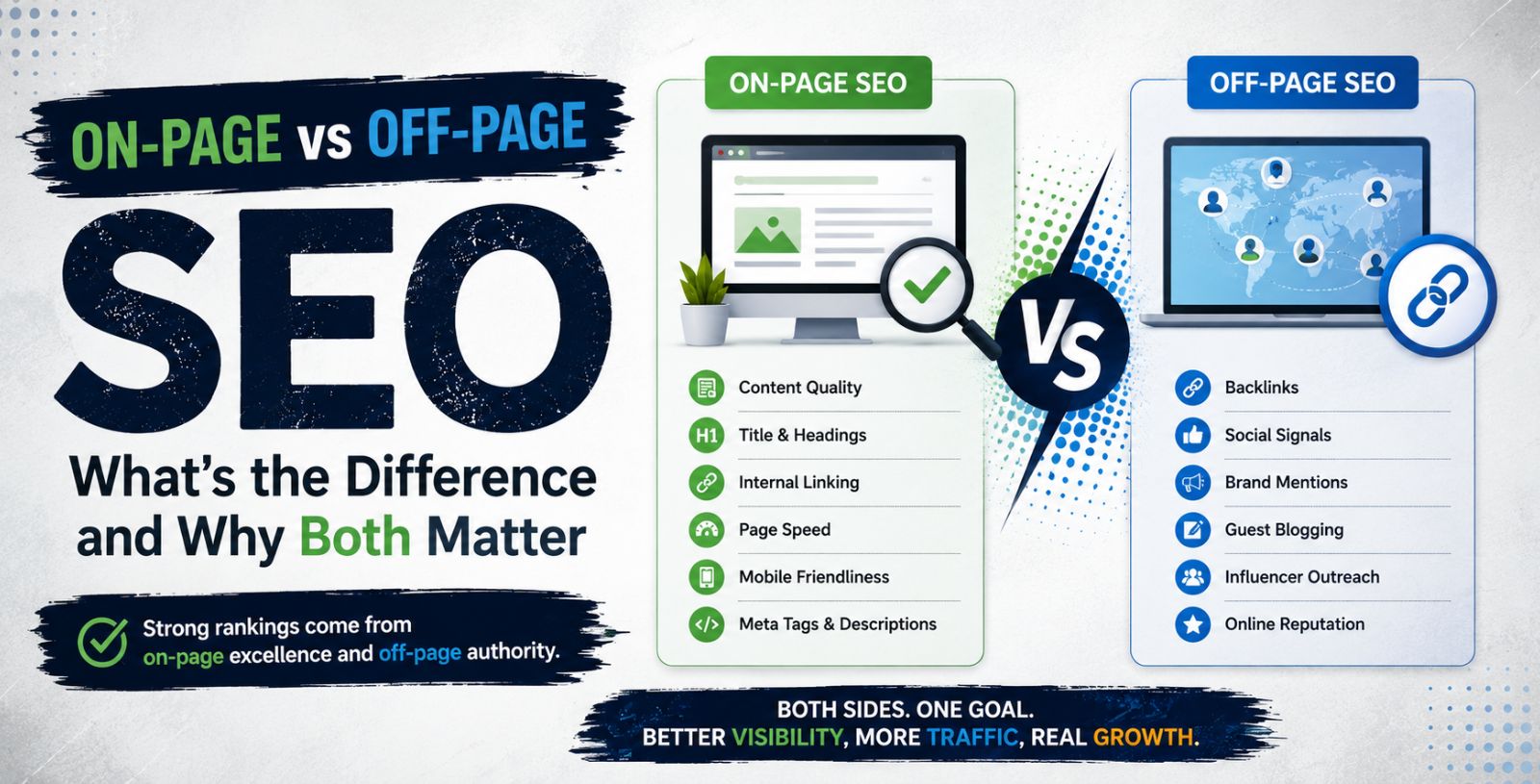
SEO is more than adding keywords to a website. It involves many strategies that work together to improve your online visibility.
Two of the most important parts are on-page SEO and off-page SEO. They have different roles, but both are essential for long-term success.
Understanding how they work helps you build a stronger SEO strategy and avoid wasting time on the wrong tactics.
What Is On-Page SEO?
On-page SEO includes everything you can control on your website. Its purpose is to help search engines understand your pages. It also improves the experience for your visitors.
Common on-page SEO elements include:
Page titles and meta descriptions.
Heading structure.
High-quality content.
Relevant keywords.
Internal links.
Image optimisation.
Page speed.
Mobile-friendly design.
Every page should provide useful information and answer the visitor's search intent.
Why Is On-Page SEO Important?
On-page SEO creates the foundation of your website. Even strong backlinks cannot help a page with poor content or technical issues.
Good on-page SEO helps search engines understand your website. It also encourages visitors to stay longer and explore more pages. A better user experience often leads to better SEO performance.
What Is Off-Page SEO?
Off-page SEO includes activities that happen outside your website. These signals help search engines measure your website's authority and trustworthiness.
The most common off-page SEO activities include:
Earning quality backlinks.
Local business citations.
Brand mentions.
Customer reviews.
Digital PR.
Social media visibility.
These signals show search engines that other people trust your business.
Why Is Off-Page SEO Important?
Search engines want to recommend trusted websites. Backlinks from reputable websites act like recommendations. They tell search engines that your content is valuable.
However, quality is more important than quantity. A few links from trusted websites are worth far more than hundreds of low-quality links.
On-Page SEO vs Off-Page SEO
Although both support rankings, they serve different purposes.
On-Page SEO focuses on your website. It improves content, structure, speed, and user experience.
Off-Page SEO focuses on your reputation. It builds authority through backlinks, mentions, and external signals.
Think of it this way - On-page SEO helps create a great website. Off-page SEO helps other people trust that website. Both are needed for long-term success.
Can One Work Without the Other?
Not very well. A well-designed website with no authority may struggle to rank. Likewise, a website with many backlinks may still perform poorly if the content is weak.
The best SEO strategies balance both areas. Strong content attracts visitors. Strong authority helps search engines trust that content.
How Can Small Businesses Improve Both?
You do not need a huge marketing budget. Start with the basics.
For on-page SEO:
Write helpful content.
Improve website speed.
Optimise page titles.
Use clear headings.
Add internal links.
For off-page SEO:
Earn backlinks naturally.
Collect customer reviews.
Build local citations.
Share useful content.
Develop relationships with trusted websites.
Small improvements made consistently can produce lasting results.
Common Mistakes to Avoid
Many businesses focus on only one part of SEO.
Some create excellent content but never promote it.
Others buy poor-quality backlinks instead of improving their website.
Both approaches limit long-term growth.
A balanced SEO strategy delivers better and more sustainable results.
Final Thoughts
On-page SEO and off-page SEO are equally important. One improves your website. The other builds your online reputation. When both work together, your website becomes easier to find and more trusted by search engines.
At NaughtyBytes Studio, SEO strategies combine strong on-page optimisation with ethical off-page techniques. This balanced approach helps businesses improve visibility while supporting long-term growth.
FAQs
1. What is the main difference between on-page and off-page SEO?
On-page SEO improves your website, while off-page SEO builds your website's authority through external signals.
2. Which is more important, on-page or off-page SEO?
Both are important. A successful SEO strategy requires a balance of each.
3. Does content affect on-page SEO?
Yes. Helpful, well-structured content is one of the most important on-page ranking factors.
4. Are backlinks still important?
Yes. High-quality backlinks remain a strong signal of trust and authority.
5. Can small businesses benefit from both types of SEO?
Absolutely. Combining on-page and off-page SEO helps small businesses improve visibility and attract more qualified customers.
In short: A successful SEO strategy needs both strong website optimisation and trusted external signals. Discover the key differences and why balancing both leads to better long-term results.