How to Get Your Business Found on ChatGPT in 2026
Your next customer might not search for a business by typing two or three words into Google.
They might ask:
“Can you recommend a reliable web designer in Sheffield for a small business?”
Or:
“Which local company can improve my website and help me rank on Google?”
ChatGPT can now search the live web and provide answers containing links to relevant websites. That means businesses have another opportunity to be discovered—but there is no magic submission button, secret AI switch or guaranteed number-one position.
The good news is that much of what helps a business appear in AI-powered search is already familiar: a technically sound website, clear information, useful content, credible mentions and proper SEO.
No faff. No mysterious AI wizardry. Just a business that is easy to find, understand and trust.
The quick answer
To improve your chances of being found through ChatGPT:
Make sure OpenAI’s search crawler can access your website.
Check that your important pages are public and indexable.
Clearly explain what your business does and where it operates.
Create strong pages for each main service.
Add accurate organisation or local-business structured data.
Publish original, genuinely useful content.
Keep your business details consistent across the web.
Build genuine reviews, mentions and authority.
Make your website fast, mobile-friendly and easy to use.
Track visits arriving from ChatGPT.
OpenAI says any public website can potentially appear in ChatGPT search. Its guidance focuses on making content discoverable, accessible to OAI-SearchBot and easy to cite—not on paying for or guaranteeing an organic position.
What does “being found on ChatGPT” actually mean?
A business can appear in several different ways.
Your company may be named in an answer
Someone could ask for a recommended business, service provider or product. ChatGPT may include your company among its suggestions when your business is relevant to the question and supported by information available on the web.
Your website may be cited as a source
ChatGPT search answers can contain clickable citations. A useful guide, service page, case study or original piece of research could become one of those sources.
Your page may appear as a relevant link
Users can open a Sources panel beneath search-based answers to see cited pages and other relevant links. This gives businesses an opportunity to receive visits even when their name is not included prominently in the main answer.
Being “found on ChatGPT” therefore is not one fixed ranking. Visibility can change depending on:
The exact question being asked
The user’s location and context
How clearly your website answers the question
Whether your information can be verified
Which current web sources are available
Whether your website can be crawled
That is why no responsible SEO company should promise a permanent first-place ChatGPT ranking.
How does ChatGPT discover websites?
OpenAI uses a crawler called OAI-SearchBot to surface websites in ChatGPT search.
OpenAI’s current publisher guidance says that public websites can appear in search and recommends allowing this crawler to access content that you want included in summaries, snippets and citations. Sites that block OAI-SearchBot will not normally appear within ChatGPT search answers, although their titles and links may still appear in limited navigational circumstances.
It is important to understand that OAI-SearchBot and GPTBot have different purposes:
OAI-SearchBot relates to appearing in ChatGPT search.
GPTBot relates to content that may be used to improve OpenAI’s foundation models.
OpenAI allows website owners to manage these independently. You can allow your pages to appear in search while choosing not to allow them to be used for model training.
1. Check whether OAI-SearchBot can access your website
Your website’s robots.txt file tells crawlers which parts of your site they can access.
A basic rule allowing OpenAI’s search crawler looks like this:
User-agent: OAI-SearchBot
Allow: /
A business that wants to allow ChatGPT search access while opting out of potential training use could use rules similar to:
User-agent: OAI-SearchBot
Allow: /
User-agent: GPTBot
Disallow: /
Do not replace your existing robots.txt file blindly. It may contain important rules for Google, Bing, development areas, customer accounts or private sections of your website.
Ask your developer or SEO provider to check:
Whether OAI-SearchBot is blocked
Whether a security plugin is blocking unknown crawlers
Whether Cloudflare or another firewall is denying access
Whether the relevant OpenAI IP ranges are permitted
Whether your pages return a normal successful response
OpenAI says changes to robots.txt may take roughly 24 hours to be reflected in its search systems. That does not mean your business will appear within 24 hours; it only means the crawler rules should have been recognised.
2. Make sure your pages can actually be indexed
Allowing one crawler is not enough if the rest of your website is difficult to access.
Important pages should:
Return a successful 200 status
Avoid accidental noindex tags
Load without requiring an account
Be linked from the main website
Appear in your XML sitemap
Use a sensible page structure
Have unique page titles and headings
Contain useful text—not just images
Work properly on mobile devices
Google gives similar advice for visibility in both conventional and AI-driven search. Pages must be accessible, indexable and technically sound before search systems can properly consider them.
Check your most important pages in Google Search Console. If Google cannot crawl or understand them, there is a fair chance other web-based discovery systems will struggle too.
3. Make it obvious who you are, what you do and where you work
Many business websites look impressive but never clearly state what the company actually does.
A vague homepage might say:
“Helping ambitious brands reach their full potential.”
That sounds polished, but it tells a search system very little.
A clearer introduction would be:
“NaughtyBytes Studio is a Sheffield-based web design and SEO agency helping small businesses across Yorkshire and the UK attract more customers online.”
Within one sentence, the page identifies:
The company
The main services
The home location
The target market
The wider service area
Include your core business information naturally across your:
Homepage
About page
Contact page
Website footer
Service pages
Social profiles
Relevant directory listings
Use the same recognised company name, phone number, email address and location wherever possible. Conflicting information makes your business harder for customers—and machines—to verify.
4. Create a proper page for every important service
Do not expect one homepage to rank for every service you provide.
A web and SEO agency might need individual pages for:
Google Ads management
Each page should answer the questions a prospective customer would naturally ask:
What is the service?
Who is it for?
What is included?
What problem does it solve?
How much might it cost?
Why should the customer choose you?
What should they do next?
This gives search systems a much clearer understanding of the situations in which your business is relevant.
The same principle applies to a plumber, accountant, gym, solicitor, restaurant or beauty business. A plumber offering emergency call-outs, boiler repairs and bathroom installations should explain each service properly rather than listing all three in one small paragraph.
5. Build location relevance without producing spammy city pages
Local businesses should clearly describe where they work.
For example, NaughtyBytes could naturally discuss:
Web design in Sheffield
SEO services in Sheffield
Local SEO across South Yorkshire
Website projects throughout Yorkshire
UK-wide support for suitable businesses
But creating 100 nearly identical pages with only the place name changed is not a strong strategy.
A useful location page should include genuinely local and service-specific information, such as:
Services available in that area
Examples of local work
Relevant customer problems
Areas or districts covered
Local testimonials
Travel or appointment information
A clear local enquiry route
Original photographs or examples
Google advises businesses to create helpful, original content rather than producing large quantities of interchangeable pages designed mainly to capture search traffic. It also warns that using generative AI to produce pages at scale without adding genuine value may fall under its spam policies.
One cracking Sheffield page is worth more than dozens of thin pages that say the same thing.
6. Add accurate structured data
Structured data is machine-readable information placed within a page’s code. It can help search engines understand the organisation, services and content represented on the page.
For many small businesses, useful types include:
Organization
LocalBusiness
A relevant subtype such as ProfessionalService
Article
BreadcrumbList
WebSite
Appropriate organisation information may include:
Business name
Website address
Logo
Main telephone number
Business address
Opening hours
Social-profile links
Service area
Google says organisation structured data can help it understand and distinguish a company, while LocalBusiness markup can describe details such as location, opening hours and contact information.
Structured data must match the information visitors can see on the page. Do not add fake reviews, false opening hours, locations you do not operate from or services you do not genuinely provide.
Correct schema gives machines clearer information. It does not guarantee rankings, rich results or ChatGPT recommendations. Google explicitly states that valid structured data creates eligibility for certain features but does not guarantee that they will appear.
7. Publish content worth quoting
Generic articles are becoming easier than ever to produce.
That means another bland post called “Five Ways to Improve Your Marketing” is unlikely to make your business stand out.
Create material that contains something original:
Real case studies
Before-and-after results
Original surveys
Local market analysis
Screenshots and examples
Practical templates
Downloadable checklists
Expert commentary
Lessons from completed projects
Clear answers based on first-hand experience
For NaughtyBytes, stronger article ideas might include:
What we found after auditing 50 Sheffield business websites
The most common local SEO mistakes made by Yorkshire trades
How much a professional small-business website really costs in 2026
Before and after: rebuilding a slow five-page business website
We tested 30 Sheffield websites on mobile—here is what went wrong
Which local directories actually send traffic to Yorkshire businesses?
A complete website-launch checklist for UK small businesses
Google’s current AI-search guidance recommends producing distinctive, expert-led material that goes beyond generic information anyone could have written. It describes this as creating useful, non-commodity content.
Original content gives people a reason to share your page and gives AI-search systems a reason to cite it.
8. Answer questions directly
People often communicate with AI search in complete, detailed questions.
Instead of searching:
“web designer Sheffield”
They might ask:
“Who can rebuild my slow WordPress website in Sheffield without charging agency prices?”
Your content should still use relevant search terms, but it should also answer the wider question behind them.
A useful format is:
Put the real customer question in an H2 or H3 heading.
Give a direct answer immediately below it.
Add examples, context and evidence.
Explain exceptions or limitations.
Finish with a clear next step.
For example:
How much does a small-business website cost in Sheffield?
A professionally built small-business website will usually cost more than a DIY template but less than a complex bespoke platform. The final price depends on the number of pages, required features, content, integrations and level of custom design.
The reader gets an immediate answer, while the rest of the section can explain the detail.
ChatGPT search is designed to support conversational questions and follow-up requests, while Google says users of AI search experiences frequently ask longer, more specific questions.
Write naturally. Cover the subject properly. Do not force the same keyword into every paragraph.
9. Strengthen your reputation beyond your own website
Your website is important, but it is not the only public source of information about your business. Keep accurate profiles on platforms relevant to your organisation, which may include:
Google Business Profile
Bing Places
Companies House
Industry directories
Local business directories
Professional memberships
Trusted review platforms
Social-media profiles
Local press websites
Supplier or partner websites
This is not about creating hundreds of low-quality directory links. It is about establishing a consistent, credible public footprint.
Your profiles should agree on basic details such as:
Company name
Main location
Website
Telephone number
Services
Opening times
Business description
Genuine reviews also help customers judge whether they can trust you. They may additionally create useful third-party pages containing real descriptions of your service.
There is no published ChatGPT formula that awards a set number of points for reviews or directory listings. The practical benefit is that consistent independent information makes a business easier to verify and less dependent on claims made solely on its own website.
10. Make your website work brilliantly on mobile
Getting cited is only useful if the visitor who clicks through has a good experience.
Your website should:
Load quickly
Display properly on small screens
Use readable text
Have clear navigation
Avoid intrusive pop-ups
Use large, easy-to-tap buttons
Make phone and enquiry actions obvious
Keep the main information near the top
Use descriptive labels on forms and controls
Google advises site owners to provide a strong page experience across devices and ensure visitors can easily distinguish and use the main content. OpenAI also recommends clear accessibility labels and roles for interactive elements used by agentic browser experiences.
A page that attracts traffic but frustrates every mobile visitor is not doing its job.
11. Track visits from ChatGPT
You should measure whether ChatGPT is sending people to your website.
OpenAI says referral links from ChatGPT automatically include:
utm_source=chatgpt.com
This allows publishers to identify incoming ChatGPT traffic using platforms such as Google Analytics.
Within your analytics, monitor:
Visits from chatgpt.com
Landing pages receiving those visits
Enquiry-form completions
Phone-button clicks
Time spent on the page
Other pages viewed
Leads that mention ChatGPT
Do not only track traffic volume. Ten relevant visitors who become enquiries may be more valuable than hundreds who leave immediately.
It is also worth testing your own visibility manually every month.
Try questions such as:
“Recommend a web designer in Sheffield for a small business.”
“Who offers local SEO services in South Yorkshire?”
“Which Sheffield agencies build booking websites?”
“Find a Yorkshire web company that supports adult businesses.”
“Who can rebuild an outdated WordPress website in Sheffield?”
Record:
Whether your company appears
Which competitors appear
Which pages are cited
Which third-party websites are used
What information is missing from your own website
Use the findings to improve your content—not to copy competitors word for word.
ChatGPT SEO mistakes to avoid
Blocking the search crawler
You cannot expect your pages to appear properly if OAI-SearchBot cannot access them.
Publishing hundreds of AI-generated pages: Mass-producing generic articles or near-identical city pages is unlikely to build a strong, trustworthy website. Google specifically advises against scaled AI content that adds little value.
Stuffing pages with “ChatGPT SEO” keywords: Use phrases naturally where relevant. Repeating them unnecessarily will make the article harder to read and will not make your business more credible.
Adding information only inside schema: Important information should be visible to visitors as well as included in structured data.
Buying fake reviews or mentions: False reviews and manufactured endorsements can damage trust and may violate platform rules.
Treating llms.txt as a magic fix: An experimental AI text file will not compensate for blocked pages, unclear services, poor content or a broken website. Google’s current generative-search guidance explicitly tells site owners to prioritise established SEO practices rather than unnecessary AI files or supposed AEO and GEO tricks.
Expecting permanent recommendations: AI answers can change with the question, timing, location and available sources. Treat visibility as something to improve and monitor, not a position you permanently own.
A 10-minute ChatGPT visibility check
Run through this quick checklist:
Search your company name in ChatGPT
Ask ChatGPT what your business does
Ask for businesses providing your service in your location
Check whether your important pages are indexed by Google
Open your robots.txt file and look for OAI-SearchBot
Check that your homepage states your service and location clearly
Check your phone number and business name across major profiles
Review your title tags and page headings
Test the website on an actual mobile phone
Check analytics for traffic from chatgpt.com
Any incorrect, missing or unclear answer gives you something useful to improve.
How long does it take to appear in ChatGPT?
There is no fixed timescale.
OpenAI says a change to crawler permissions may take around 24 hours to be recognised. Appearing for a useful customer question may take considerably longer—or may not happen at all—depending on relevance, available sources and the quality of competing information.
The process may involve:
Fixing technical access
Improving service pages
Publishing useful content
Correcting third-party profiles
Building genuine authority
Waiting for pages to be recrawled
Monitoring results over time
Treat AI visibility as part of long-term SEO, not as an instant advertising switch.
Frequently asked questions
1. How do I add my business to ChatGPT?
There is no standard organic business-registration form that guarantees inclusion in ChatGPT answers. OpenAI says any public website can potentially appear. Start by making your site accessible to OAI-SearchBot, clearly explaining your business and publishing useful information.
2. Do I need to allow GPTBot to appear in ChatGPT search?
No. OpenAI treats GPTBot and OAI-SearchBot as separate controls. A business can allow the search crawler while blocking the crawler associated with potential model training.
3. Can ChatGPT find a website that blocks OAI-SearchBot?
OpenAI says sites blocking OAI-SearchBot will not be shown within normal ChatGPT search answers. A title and link may still appear in limited navigational situations when the URL is known from elsewhere, but the page will not be available for normal summaries and snippets.
4. Does the schema guarantee that my company will appear?
No. Accurate schema can help machines understand your business, but neither Google nor OpenAI guarantees visibility simply because structured data is present. The visible page, technical setup, relevance and overall quality still matter.
5. Do reviews help my business appear in ChatGPT?
There is no published formula confirming that a particular number of reviews will produce a ChatGPT recommendation. Genuine reviews are still valuable because they build customer trust and create independent public information about your service.
6. Do I need an llms.txt file?
Not as a replacement for normal SEO. Focus first on crawlability, clear content, useful service pages, structured data and a trustworthy public presence. Google currently advises site owners not to chase unnecessary AI-search files as a shortcut.
7. Is ChatGPT SEO different from Google SEO?
There are differences in how answers are presented, but the foundations overlap heavily. Both benefit from accessible pages, clear site structure, relevant content and accurate business information. Strong conventional SEO is therefore a sensible foundation for AI-search visibility.
8. How can I track traffic from ChatGPT?
Look for referral visits containing utm_source=chatgpt.com in your analytics platform. OpenAI automatically adds this parameter to ChatGPT referral links.
9. Can an SEO agency guarantee that ChatGPT will recommend my business?
No responsible agency should guarantee a specific organic recommendation. An agency can improve your website’s technical setup, content, local presence and authority, but the final response is determined by the search system and the user’s individual question.
Final Thoughts
Getting your business found on ChatGPT is not about tricking an AI system. It is about making your company easy to discover, understand and verify.
Start with the fundamentals:
A crawlable website
Clear service and location information
Strong individual service pages
Accurate structured data
Original content
Consistent business profiles
Genuine reviews
A brilliant mobile experience
Proper measurement
Businesses that already invest in helpful content and ethical SEO are in the strongest position to benefit as AI-powered search develops.
The names may change—SEO, AI SEO, AEO or GEO—but the main job remains the same:
Provide the clearest and most useful answer when a potential customer needs what you offer.
No secret hacks. No empty promises. Just a website that does the hard graft.
Call to action
Can ChatGPT and Google understand your business?
NaughtyBytes Studio helps businesses improve their websites, search visibility and local presence with straight-talking advice and proper Yorkshire service.
Our free website and AI-visibility review can check:
Search-engine crawlability
ChatGPT crawler access
Service-page structure
Local-business signals
Structured data
Mobile performance
Content opportunities
Conversion problems
Get your free website audit. No obligation. No mither.
Publishing instructions
Use these internal links naturally within the article:
professional SEO support → /seo
local SEO services → /local-seo
professional web design → /web-design
website rebuild → the website-rebuild service page
free website audit → the current audit form or contact page
Link “what is SEO?” to /blog/what-is-seo-does-my-small-business-need-it
Link “how long SEO takes” to /blog/how-long-does-seo-actually-take-to-work
Add:
A clickable table of contents below the introduction
Article structured data
Organization or ProfessionalService structured data site-wide
Breadcrumbs
A visible updated date
An author box for Manu, Head of SEO
A mobile-friendly FAQ accordion
A CTA after the technical-crawler section
A second CTA immediately before the FAQs
A downloadable AI Search Visibility Checklist
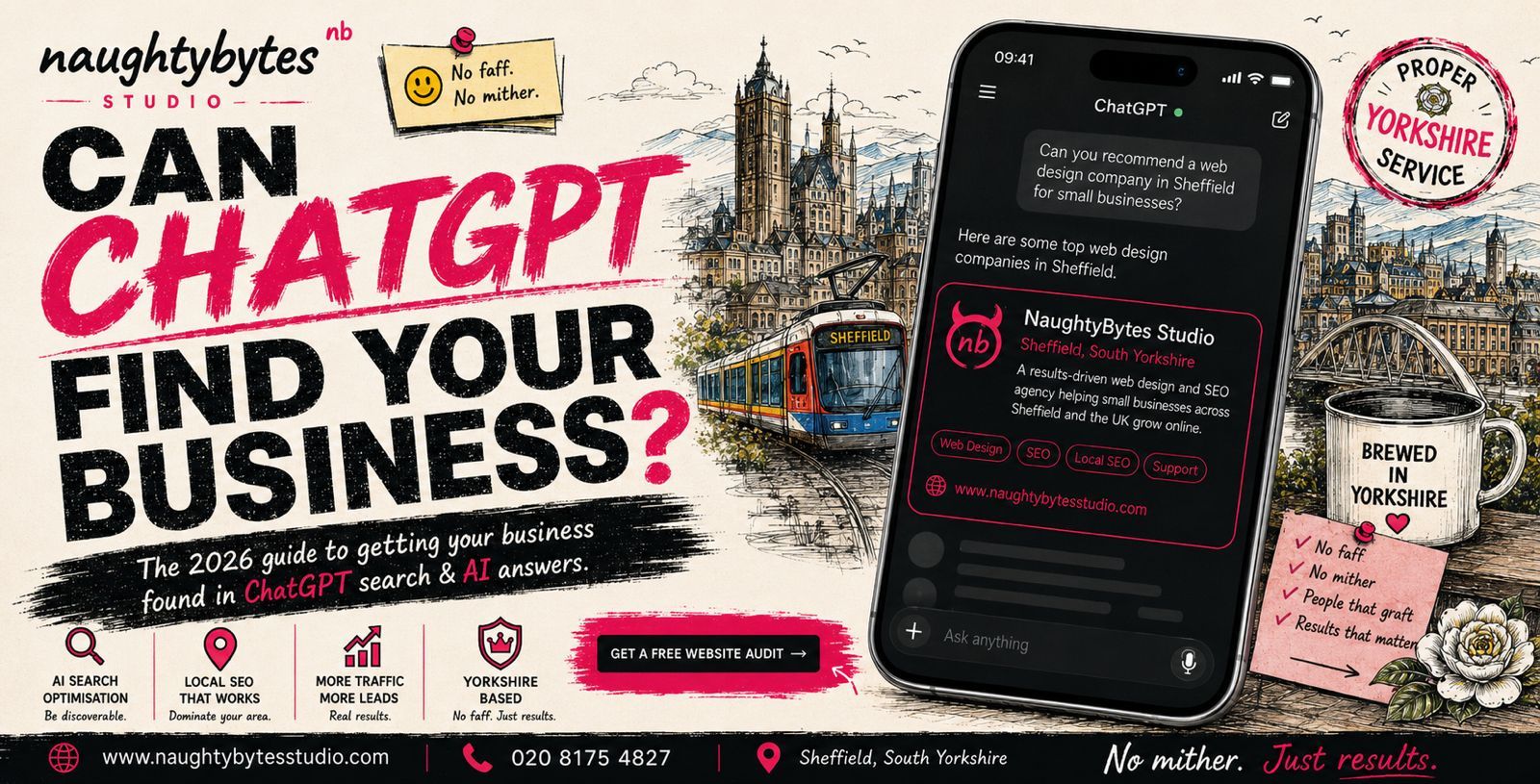
The strongest featured-image concept is a mobile phone displaying an AI answer beside a recognisable Sheffield skyline, with the large text “CAN CHATGPT FIND YOUR BUSINESS?” Keep the design in NaughtyBytes pink, cream and black rather than using a generic blue AI aesthetic.
In short: Want your business to appear in ChatGPT search and recommendations? This no-faff guide explains how to make your website easier for AI search tools to discover, understand and cite.